


Introduction
That morning stiffness in your knee. The grinding sensation when you climb stairs. The dull ache after sitting too long. These are not just signs of aging-they are the language of osteoarthritis (OA) , a degenerative joint disease affecting over 500 million people worldwide.
At the center of this problem lies a remarkable biological fluid: synovial fluid.
The Role of Natural Synovial Fluid and Hyaluronic Acid in Healthy Joints
In a healthy knee, synovial fluid acts as both lubricant and shock absorber. This clear, viscous fluid is produced by the synovial membrane and contains one critical molecule-hyaluronic acid (HA) .
HA is a natural mucopolysaccharide that gives synovial fluid its unique viscoelastic properties. Think of it as the oil in an engine: it reduces friction between cartilage surfaces during movement (lubrication) and cushions the joint during impact (shock absorption).
"The properties of synovial fluid depend entirely on the concentration of HA and its molecular weight."
When your knee bends, the HA molecules align to reduce friction. When you jump or step down, they entangle to absorb force. This dual function is why healthy knees move smoothly and painlessly-even after decades of use.

How Osteoarthritis Degrades the Lubricant Fluid in the Knee Joint
Osteoarthritis is not simply "wear and tear." It is a degenerative, progressive disease that fundamentally changes the composition of synovial fluid.
| Stage | Condition |
|---|---|
| Healthy Knee | Synovial fluid is rich in high-molecular-weight HA. Cartilage is protected. |
| Mild to Moderate OA | HA concentration drops. Molecular weight decreases. Fluid becomes watery. |
| Severe OA | Synovial fluid loses viscoelasticity. Bone-on-bone friction causes pain, swelling, and stiffness. |
As OA progresses, the body's natural HA production declines. The result? A vicious cycle: less lubrication → more friction → cartilage breakdown → inflammation → even less HA production.
This is where artificial synovial fluid injections-also known as viscosupplementation-change the game.
How It Works: The Science Behind Synovial Joint Fluid Injections
Viscosupplementation: A Biophysical Cushion
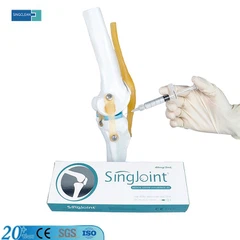
Viscosupplementation is a minimally invasive procedure in which medical-grade hyaluronic acid gel is injected directly into the osteoarthritic joint. The goal is simple but powerful: restore what OA has destroyed.
Once injected, exogenous HA:
Replaces the degraded pathological synovial fluid
Restores viscoelasticity and lubricating capacity
Reduces pain by mechanically protecting nerve endings
Improves joint function and mobility
Unlike oral painkillers that mask symptoms, viscosupplementation targets the mechanical root cause of OA pain-loss of joint lubrication.
"Exogenous HA can enhance chondrocyte HA synthesis, prevent cartilage degradation, and promote its regeneration."
- Migliore A, Procopio S. (2015)
Why Synovial Injections Act as Effective Synovial Fluid Replacement
Not all HA injections are equal. True synovial fluid replacement requires more than just HA-it requires HA with the right molecular weight, concentration, and purity.
Here's why HA works so effectively as an artificial synovial fluid:
1. Biophysical Cushioning
High-molecular-weight HA forms a protective layer over cartilage, reducing shear stress and mechanical loading. This is particularly important for weight-bearing joints like the knee.
2. Biochemical Regeneration
Research by M.M. Smith and P. Ghosh (1987) showed that exogenous HA binds to receptors on synovial fibroblasts. When intermediate-molecular-weight HA is used, strong binding occurs, and the high number of receptors stimulated enhances endogenous HA biosynthesis.
In plain English: the injection not only lubricates-it teaches your joint to make more of its own lubricant.
3. Anti-Inflammatory Effects
HA reduces the production of:
Proinflammatory mediators
Matrix metalloproteinases (MMPs) involved in cartilage breakdown
This dual mechanical + anti-inflammatory action makes HA injections uniquely effective for mild-to-moderate OA.

Clinical Evaluation Criteria: Choosing the Right Knee Joint Lubrication Shots
For medical distributors, hospital procurement managers, and orthopedic clinics, not every joint lubricant injection delivers the same results. Clinical outcomes depend on four key parameters.

Key Parameters of an Ideal Knee Joint Lubrication Fluid
| Parameter | Why It Matters | Ideal Range (SingJoint®) |
|---|---|---|
| HA Concentration | Higher concentration = greater viscosity & longer residence time | 10–20 mg/mL |
| Molecular Weight (MW) | Higher MW = better shock absorption & slower degradation | ≥1.0M – ≥1.6M Daltons |
| Kinetic Viscosity | Directly correlates with lubrication duration | 5–10× higher than competitors |
| Osmolality | Matches human physiology → better biocompatibility, less injection pain | ~313 mOsm/kg |
Clinical Regimens: Single vs. Multi-Injection
| Regimen | Concentration | MW | Injections | Duration | Best For |
|---|---|---|---|---|---|
| Standard Series | 10–12 mg/mL | ≥1.0M Da | 3–4 | 6 months | Patients preferring cost flexibility |
| Single Injection | 20 mg/mL | ≥1.6M Da | 1 | >6 months | Faster recovery, higher compliance |
Both regimens are EP-approved and use non-animal sourced HA (bio-fermentation), eliminating immunogenicity risks.
The Manufacturer's Perspective: What Medical Distributors Must Check Before Importing
If you are sourcing synovial injections for a clinic, hospital chain, or distribution network, regulatory and quality verification is non-negotiable. Here is your 5-point checklist.
1. Sterility Validation
All HA injections must be processed in Class 10,000 (ISO 7) cleanrooms or better. Key steps:
HA preparation
Mixing tank
Filling
Terminal sterilization
SingJoint® is processed under strict cleanroom conditions with validated sterilization protocols.
2. Endotoxin Control
Endotoxins can trigger inflammatory reactions. Reputable manufacturers conduct:
Buffer solution inspection
Intermediate inspection
Final product inspection (endotoxin limits per EP/USP standards)
3. Raw Material Source
Non-animal sourced HA (via streptococcal fermentation) is preferred because it eliminates:
Risk of zoonotic diseases
Batch-to-batch variability
Immunogenic reactions
SingJoint® uses EP-approved non-animal sourced HA.
4. Molecular Weight & Viscosity Documentation
Ask for:
Viscosity-average molecular weight (not just peak MW)
Kinetic viscosity data (cP or mPas)
Degradation curve (in vitro or in vivo)
SingJoint® provides full documentation showing nearly double the MW and 5–10× viscosity of competitors.
5. Regulatory Certifications
Minimum requirements for global distribution:
ISO 13485 (Medical devices)
CE Marking (Europe)
EP (European Pharmacopoeia) compliance
Target market registration (e.g., NMPA for China, FDA 510(k) for US if applicable)
Global Viscosupplementation Market: Why This Market Is Growing Fast
The global viscosupplementation market is expanding rapidly. By 2030, it is projected to exceed $5 billion USD.
Regional Insights
| Region | Market Share | Growth Driver |
|---|---|---|
| Asia Pacific | Major | High arthritis prevalence + aging population |
| North America | Major | High adoption of non-surgical OA treatments |
| Europe | Fastest CAGR | Growing geriatric population + increased investments by market players |
For distributors, this means one thing: demand for high-quality, long-lasting joint lubricant injections is rising globally.
Clinics and hospitals are moving away from:
Short-acting corticosteroids (temporary relief, cartilage damage risk)
Oral NSAIDs (GI side effects, no disease modification)
And toward:
Viscosupplementation (symptomatic relief + potential disease modification)
Why Choose SingJoint®? Science Meets Comfort and Longevity
After evaluating clinical data, manufacturing standards, and market comparisons, SingJoint® emerges as a leading option for medical distributors and orthopedic specialists.
1. Higher Concentration, Stronger Support
SingJoint® delivers 102% higher effective HA concentration than a leading Turkey brand. For a 3.0 mL syringe labeled 30 mg/mL, the competitor actually provides only 78.4 mg of HA. SingJoint® provides the full labeled amount-or more.
2. Better Biocompatibility for a Comfortable Experience
Osmolality: 313 mOsm/kg-closely matching human synovial fluid (280–320 mOsm/kg). This means:
Less stinging during injection
Smoother integration into joint space
Minimal post-injection flare reactions
3. Longer-Lasting Performance
Viscosity: 5–10× higher than competitors
Molecular weight: Nearly double
Duration: >6 months (vs. 3–4 months for typical competitors)
"A single injection of SingJoint® delivers efficacy that lasts for up to 6 months."
4. Better Patient Compliance
Bio-fermentation → no immunogen → excellent biocompatibility
Biodegradable → no long-term foreign body reaction
Delays total knee replacement (TKR) surgery in appropriate candidates
Conclusion: Partnering with an ISO13485-Certified Manufacturer
Osteoarthritis is not going away. As global populations age and obesity rates rise, the demand for effective, non-surgical joint pain solutions will only accelerate.
For medical distributors, procurement specialists, and clinic directors, the choice is clear:
Choose evidence-based products with published clinical references
Verify technical parameters (MW, viscosity, osmolality, sterility)
Partner with ISO13485-certified manufacturers who control their own production
SingJoint® from Hangzhou Singclean Medical Products Co., Ltd. meets all of these criteria-and more.
It is not just an injection. It is a scientifically engineered synovial fluid replacement designed for long-lasting relief, patient comfort, and clinical confidence.

Get Infos About Singjoint
Ready to evaluate SingJoint® for your clinic or distribution network?
Request product samples
Request technical dossier (MW, viscosity, sterility, endotoxin reports)
Schedule a B2B consultation
References
Migliore A, Procopio S. Effectiveness and utility of hyaluronic acid in osteoarthritis. Mini Rev Clin Cases Mineral Bone Metab. 2015;12(1):31–33.
Smith MM, Ghosh P. The synthesis of hyaluronic acid by human synovial fibroblasts is influenced by the nature of the hyaluronate in the extracellular environment. Rheumatol Int. 1987;7:113-122.
Singclean Medical. SingJoint® Medical Sodium Hyaluronate Gel Product Introduction. Internal document.