


For ophthalmic surgeons and distributors, selecting the right ophthalmic viscosurgical device (OVD) is a critical decision that directly affects surgical outcomes, patient safety, and operational efficiency. Understanding the clinical distinction between cohesive OVD vs dispersive OVD is not just academic-it impacts chamber stability, endothelial protection, and post-operative recovery.
In this in-depth guide, we analyze real clinical data, compare market-leading HPMC-based dispersive OVDs against sodium hyaluronate gel cohesive OVDs, and demonstrate why Singclean Medical has become the first Chinese manufacturer to obtain the OVD EU Medical Device Certificate.
OVD in Ophthalmology: Why the Choice Matters
An ophthalmic viscosurgical device (OVD) is a viscoelastic solution used to maintain the anterior chamber, protect corneal endothelium, and facilitate surgical maneuvers during procedures like cataract extraction, glaucoma surgery, and corneal transplantation. The global OVD market is projected to surpass USD 1.27 billion by 2028, driven by rising cataract and glaucoma volumes.
Clinically, OVDs fall into two primary categories:
| Property | Cohesive OVD | Dispersive OVD |
|---|---|---|
| Molecular behavior | Sticks together as a single mass | Spreads out and coats tissues |
| Space maintenance | Excellent (chamber retention) | Moderate |
| Removal ease | Easy, complete | Difficult, piecemeal |
| Best use case | Routine phaco, IOL implantation, pupil expansion | Complex cases, compromised endothelium, corneal edema |
As the table shows, cohesive OVDs excel at maintaining space and being removed cleanly-a major advantage for surgeons who value efficiency and clear post-operative outcomes. Dispersive OVDs, typically composed of HPMC (hydroxypropyl methylcellulose), are better at coating tissues but are harder to remove completely.
Clinical Reality: HPMC (Dispersive) vs Sodium Hyaluronate (Cohesive)
Most dispersive OVDs on the market are formulated with HPMC. However, HPMC has inherent limitations when compared to sodium hyaluronate gel, which is now recognized as the gold standard component due to its superior biocompatibility and viscoelastic performance.
Below is a direct clinical comparison based on product specifications from leading brands versus Singclean HA OVD:
| Parameter | A****c | O**I VISC | Singclean HA OVD | Clinical Significance |
|---|---|---|---|---|
| Component | HPMC (dispersive) | HPMC (dispersive) | Sodium Hyaluronate (cohesive) | HA is the most widely used OVD component globally-better tissue-friendly |
| Classification | Dispersive | Dispersive | Cohesive | Cohesive: chamber retention + easy removal; Dispersive: coating but messy removal |
| Molecular Weight | 86,000 Daltons | >80,000 Daltons | 1,000,000 – 2,600,000 Daltons | Singclean's MW is 11–30× higher, more stable chamber maintenance |
| Viscosity | 3,000–5,000 mPa·s | Not specified | ≥100,000 mPa·s | Singclean viscosity is >20× higher, extremely stable during repeated instrument entries |
| pH | 6.0–7.8 | 7.5 | 7.0–7.4 | Matches physiological human eye environment, better endothelial preservation |
| Osmolality | 250–350 mOsm/kg | 300 mOsm/kg | 270–350 mOsm/kg | Close to tear osmolarity (300 mOsm/kg), reduces postoperative discomfort |
| Multiple concentrations | No (single conc.) | No | 1.0% / 1.5% (CE) / 2.3% / 3.0% | Enables precision selection: from easy removal to extreme space maintenance |
Key Clinical Insight from Real Data
HPMC-based OVDs have low molecular weight (≈86 kDa) and low viscosity (≤5,000 mPa·s). This means:
Less stable anterior chamber during high-speed phacoemulsification.
Difficulty expanding small/unresponsive pupils or smoothing the anterior capsule.
Incomplete removal may lead to transient intraocular pressure (IOP) spikes.
In contrast, Singclean's high molecular weight sodium hyaluronate (1.0–2.6 million Daltons) and viscosity ≥100,000 mPa·s provide:
Expansion of small/unresponsive pupils – HPMC cannot perform this.
Smoothing of the front capsule and deepening of the anterior chamber.
Exceptional endothelial protection combined with cohesive behavior.
Singclean HA OVD: Clinical & Commercial Advantages for Distributors and Clinics
Distributors and clinic procurement managers need more than clinical data-they need reliability, regulatory compliance, and market differentiation. Singclean Medical delivers on all fronts.
First Chinese OVD Manufacturer with EU Medical Device Certificate
Singclean is the first Chinese manufacturer to obtain the OVD EU Medical Device Certificate, ensuring full compliance with European MDR requirements. This is a critical advantage for distributors targeting regulated markets.
Multiple Concentrations & Sizes – Tailored for Every Surgery
While competitors offer fixed concentrations (mostly 0.02% or 2%), Singclean provides a continuous selection:
| Concentration | Best Use Case |
|---|---|
| 1.0% – 1.5% | Easy removal, excellent endothelial protection – ideal for routine phaco |
| 2.3% | Balanced performance for most cataract procedures |
| 3.0% | Extreme space maintenance for complex surgeries (e.g., traumatic cataracts, vitrectomy) |
Sizes available: 0.5ml / 0.75ml / 1.0ml / 2.0ml – convenient for different surgical needs (pediatric, routine, or premium IOL cases).
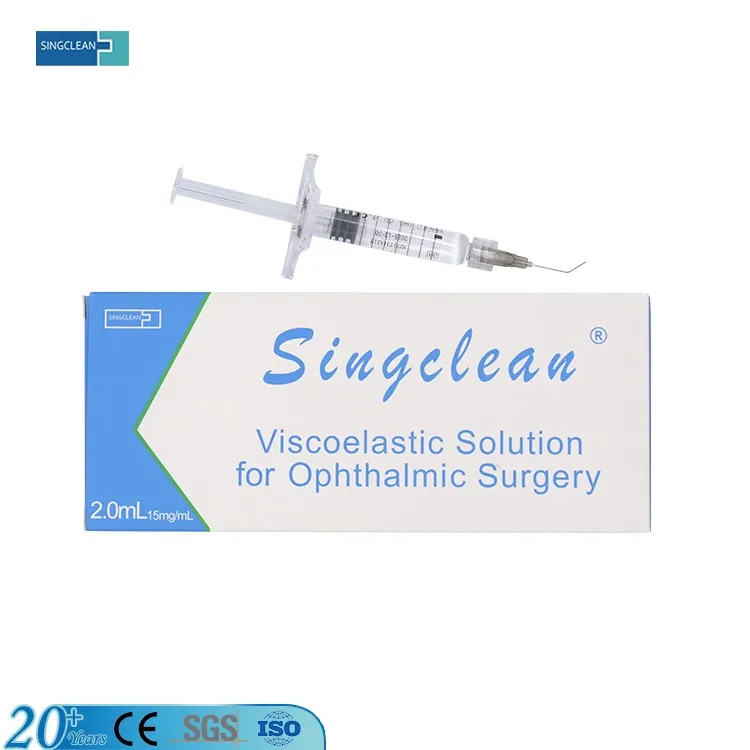
Singclean Ophthalmic Viscosurgical Device
High Purity & Biocompatibility
Singclean HA OVD is produced via bio-fermentation in GMP-level facilities, ensuring:
No animal-derived impurities
Consistent batch-to-batch quality
Low immunogenicity
pH 7.0–7.4 and osmolality 270–350 mOsm/kg make it physiologically identical to the human eye microenvironment, reducing postoperative inflammation and corneal edema.
Proven Global Track Record
Over 1.4 million units sold worldwide
Trusted by surgeons across Asia, Europe, Africa, and South America
ISO 9001:2015 certified
Environmental Management System Certificate
Clinical Scenarios: When to Choose Cohesive OVD (Singclean HA) vs Dispersive OVD
| Surgical Scenario | Recommended OVD Type | Why |
|---|---|---|
| Routine cataract surgery | Cohesive (Singclean HA) | Maintains chamber, easy removal, no IOP spike |
| Hard cataract / small pupil | Cohesive (Singclean HA 2.3% or 3.0%) | Expands pupil, deepens chamber, smooths capsule |
| Fuchs' dystrophy / low endothelial count | Dispersive or Soft-shell (Dispersive + Cohesive) | Dispersive coats endothelium; cohesive maintains space |
| Glaucoma + cataract combo | Cohesive | Easy removal avoids IOP elevation |
| Pediatric cataract | Cohesive (Singclean HA 1.0% or 1.5%) | Smaller volume, easy removal, excellent protection |
Why Switch from HPMC to Sodium Hyaluronate OVD?
If your clinic or distribution portfolio still relies on HPMC-based OVDs, here is the business and clinical case for switching to sodium hyaluronate gel:
| Factor | HPMC (Dispersive) | Sodium Hyaluronate (Cohesive) – Singclean |
|---|---|---|
| Chamber stability | Moderate | High (≥100,000 mPa·s) |
| Pupil expansion | Cannot | Yes (unique advantage) |
| Removal completeness | Incomplete | Complete, easy |
| Post-op IOP spike risk | Higher | Lower |
| Endothelial protection | Good | Excellent (plus biocompatibility) |
| Surgeon satisfaction | Moderate | High |
| Competitive differentiation | Low (many HPMC brands) | High (EU-certified HA OVD with multiple conc.) |
For distributors, offering a premium sodium hyaluronate OVD allows you to:
Capture both value (routine cases) and premium (complex surgeries) segments.
Differentiate from competitors still selling HPMC.
Build long-term loyalty with surgeons who value performance.
Ready to Upgrade Your OVD Offering?
For Distributors: Join a growing global network of partners supplying Singclean CE-certified HA OVD. We offer competitive pricing, bulk orders, and marketing support.
For Clinics & Surgeons: Experience the difference of high molecular weight sodium hyaluronate. Request a sample or schedule a surgical evaluation.